Summary:
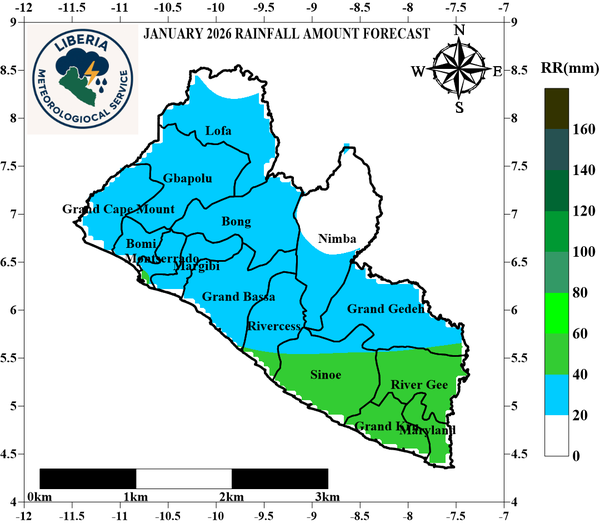
In the January 2026 forecast, cumulative rainfall across Liberia is expected to range between 20.9 mm and 58.0 mm. Higher rainfall amounts (48.9–58.0 mm) are anticipated in Sinoe, River Gee, Grand Kru, and Maryland counties, while upper Lofa and Nimba are predicted to receive less than 20.0 mm. The remaining parts of the country are expected to record rainfall between 21.0 mm and 40.0 mm.
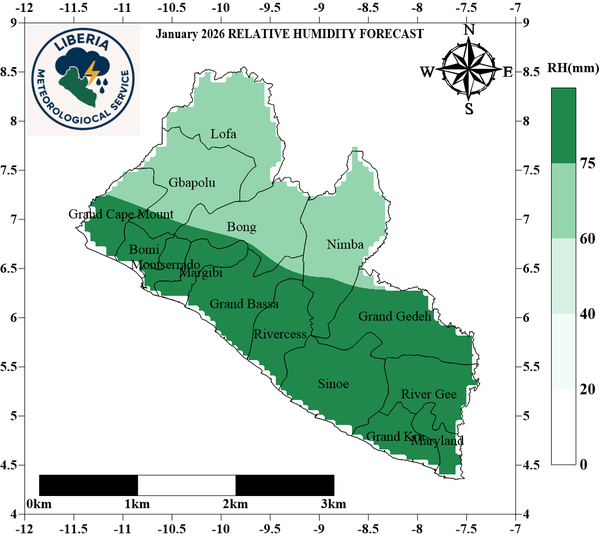
Throughout this period, Relative humidity is forecasted to range from 62.4% to 81.8% nationwide. The highest values (79.5–81.8%) are expected along the coastal and southeastern counties, while the extreme northern region is likely to experience the lowest relative humidity (62.4%). Other areas are expected to record values between 62.7% and 77.1%.
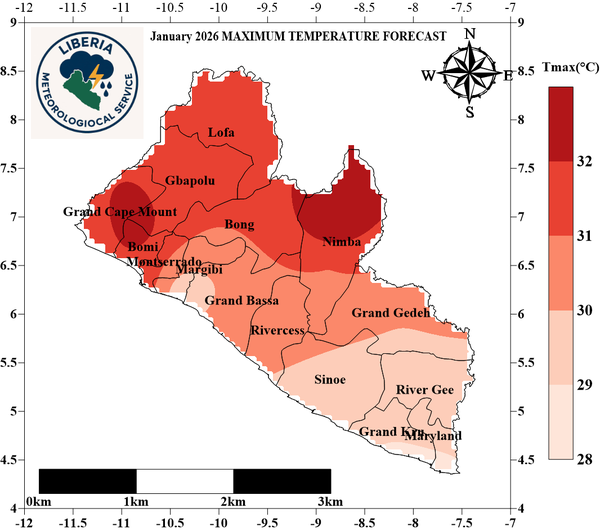
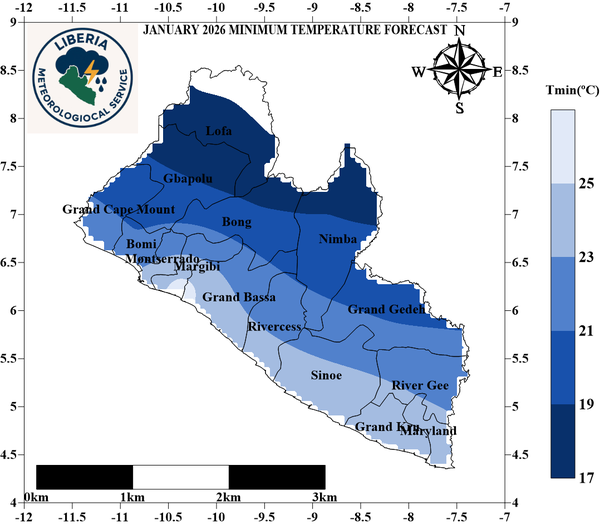
Maximum temperatures are anticipated to range from 28.9°C to 32.1°C. Lower maximum temperatures are expected over Maryland, River Gee, Grand Kru, and Sinoe, while higher values are forecasted for the northern and western regions. Minimum temperatures are projected to range between 17.4°C and 25.9°C, with the lowest values (16.9–19.1°C) anticipated in parts of Lofa, Gbapolu, Bong, and Nimba, and the highest minimum temperatures (up to 25.9°C) expected in coastal counties, particularly Margibi.
The mean air temperature values for January 2026 are forecasted to range between 24.3°C and 27.5°C. Lower mean temperature values between (24.0–25.0°C) are expected over Lofa and parts of Gbapolu, while higher temperature averages between (26.5–27.5°C) are anticipated across the coastal counties.
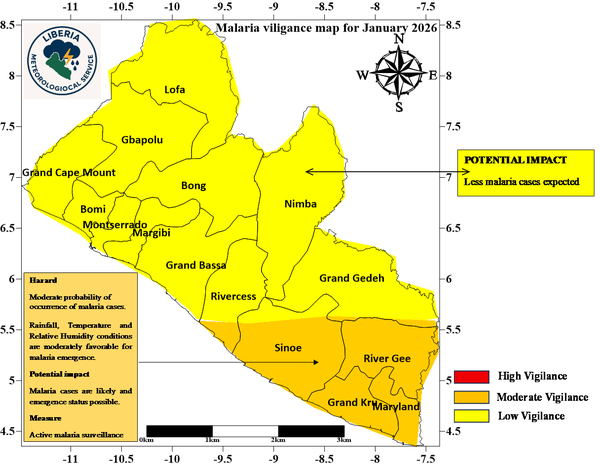
The prevailing climatic conditions suggest moderate malaria risk in Sinoe, River Gee, Grand Kru, and Maryland, while low vigilance is expected in other parts of the country during the forecast period.
Forecasted temperature and humidity conditions may contribute to drug and medication instability nationwide. High vigilance is advised for Sinoe, River Gee, Grand Kru, and Maryland, while moderate vigilance is recommended for Rivercess, Grand Gedeh, Grand Bassa, Margibi, and parts of Montserrado and Bong. Low vigilance is anticipated in the northern and southwestern regions, including Lofa, Gbapolu, Grand Cape Mount, Bomi, and parts of Nimba and Bong.
With respect to heat stress, extreme caution is advised across the country. High heat index conditions are expected in Bomi, Grand Cape Mount, and parts of Gbapolu and Montserrado, while the rest of Liberia is likely to experience cautionary heat index levels.