

CLIMATE AND HEALTHE BULLETIN FOR MAY 2026

Summary:
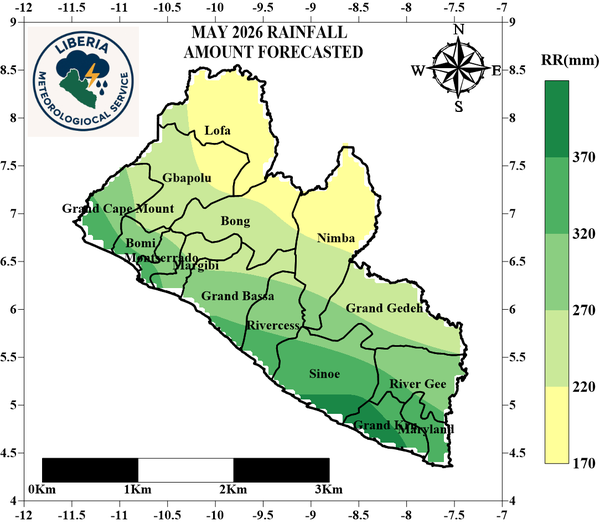
Forecasted cumulative rainfall across Liberia is expected to range between 181.6 mm and 388.7 mm. The coastal region is anticipated to record the highest rainfall amount. The central region is anticipated to record rainfall amount between 220-270mm during the period under review. Nevertheless, the north of the country is predicted to experience low rainfall between 170-220.0mm during the period under review.
Summary:
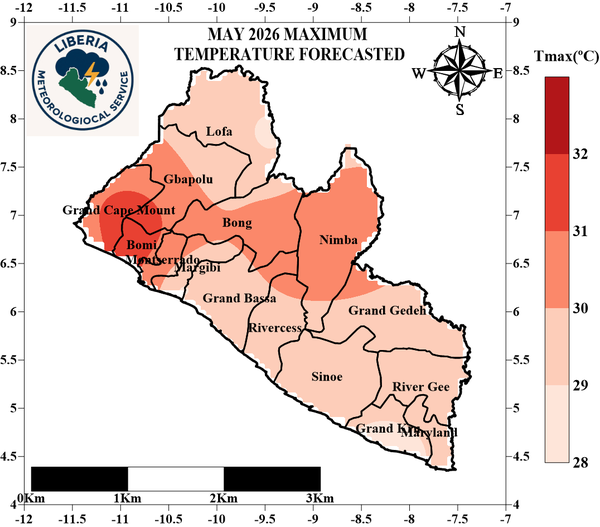
The maximum temperature in MAY 2026 is anticipated to range between 28.8°C to 31.7°C across the Country. High temperature is expected in G. Cape Mount, Bomi, Montrerrado, parts of Gbapolu, Bong and Nimba counties. Other parts of the country is anticipated to receive moderate temperature.

Summary:
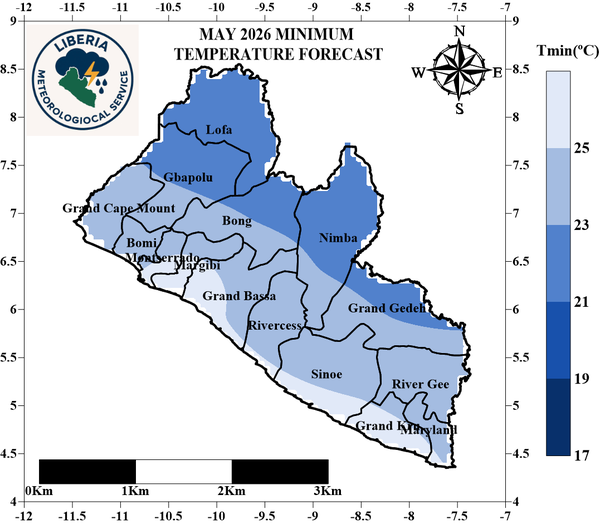
Minimum temperature across the country in May 2026 is anticipated to range between 21.6°C and 26.7°C. The highest minimum temperature is anticipated to occur along the coastal region including counties such as Maryland, Grand Kru, Sinoe, Rivercess, Grand Bassa, Margibi and Montserrado while the lowest minimum temperature is expected in Lofa and parts of Nimba, Bong, Gbapolu and Grand Gedeh counties.

Summary:
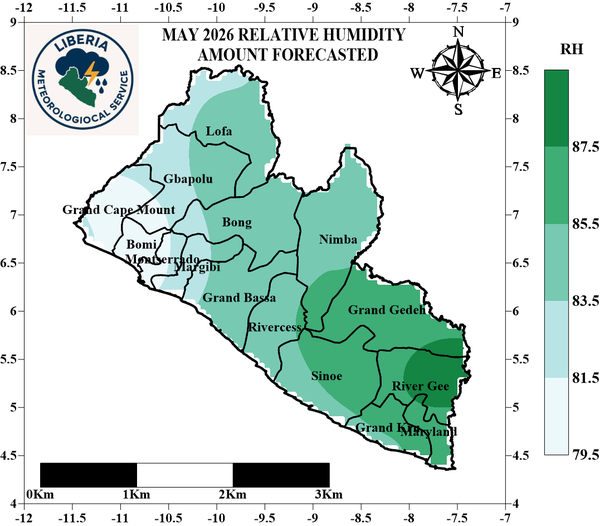
During the month of MAY high relative humidity is predicted in the southeast region affecting Rivergee, Grand Gedeh, Sinoe, Maryland and Grand Kru counties. The western region is expected to receive low relative humidity. However, the central region is predicted to experience moderate relative during this period. Average relative humidity within the month of MAY 2026 is predicted to range from 79.9% to 86.5%.

Summary:
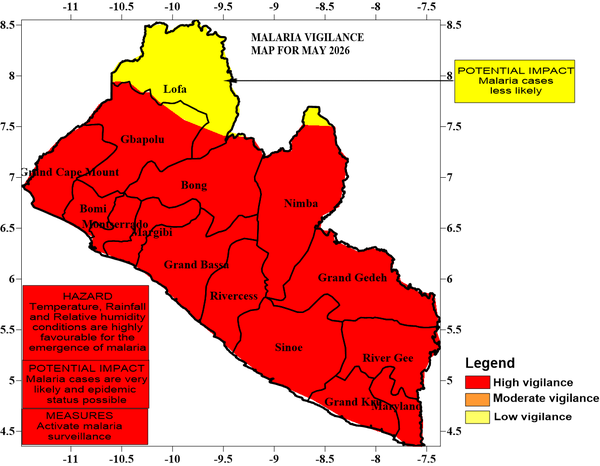
The expected climatic conditions in the month of May 2026 suggest a high prospects of malaria incidents across most parts of the country. Nevertheless, low vigilance cases are expected to occur in parts of Lofa and part of Gbapolu county.

Summary:
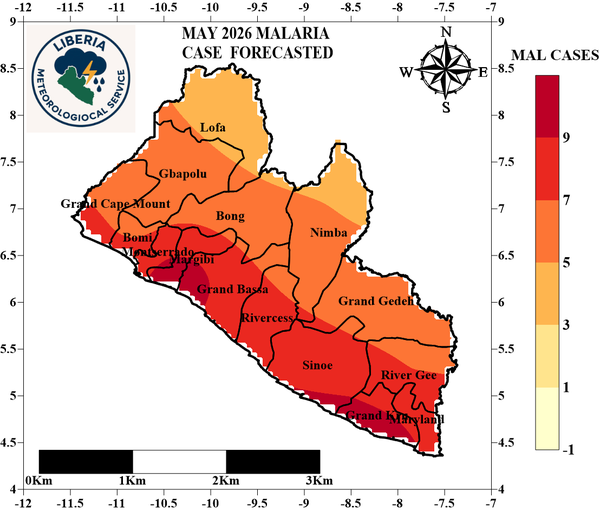
The predicted malaria case for various locations across the country for the month of May 2026 is between 4.38 to 11.1% cases per one hundred persons. The highest malaria cases are expected in parts of Margibi, Grand Bassa, Sinoe and Grand Kru counties. Low malaria cases are expected to occur in Lofa and parts of Gbapolu, Bong and Nimba counties while high malaria cases are expected in the south or coastal counties.

Highlights of the climate and health Bulletin for MAY 2026
Rainfall:
Forecasted cumulative rainfall across Liberia is expected to range between 181.6 mm and 388.7 mm. The coastal region is anticipated to record the highest rainfall amount. The central region is anticipated to record rainfall amount between 220-270mm during the period under review. Nevertheless, the north of the country is predicted to experience low rainfall between 170-220.0mm during the period under review.
Relative Humidity:
High relative humidity is predicted in the southeast region affecting Rivergee, Grand Gedeh, Sinoe, Maryland and Grand Kru counties. The western region is expected to receive low relative humidity. However, the central region is predicted to experience moderate relative during this period. Average relative humidity within the month of MAY 2026 is predicted to range from 79.9% to 86.5%..
Temperature:
Maximum temperature: Expected between 28.8°C and 31.7°C. Lofa and part of Gbapolu county are anticipated to experience low mean temperature, while the other parts of the country are expected to observe an increase in average temperature.
Minimum temperature: Forecasted to range from 21.6°C to 26.7°C. The highest minimum temperature is anticipated to occur along the coastal region including counties such as Maryland, Grand Kru, Sinoe, Rivercess, Grand Bassa, Margibi and Montserrado while the lowest minimum temperature is expected in Lofa and parts of Nimba, Bong, Gbapolu and Grand Gedeh counties.
Mean temperature: Expected between 25.6°C and 28.0°C, with relatively lower averages in Lofa and parts of Gbarpolu, county.
Malaria Cases:
Predicted malaria incidence ranges from 4.38 to 11.1 cases per 100 persons. highest malaria cases are expected in parts of Margibi, Grand Bassa, Sinoe and Grand Kru counties. Low malaria cases are expected to occur in Lofa and parts of Gbapolu, Bong and Nimba counties while high malaria cases are expected in the south or coastal counties
Malaria Vigilance:
Climatic conditions indicate a high risk of malaria transmission in most parts of the country, and lower vigilance cases are expected to occur in parts of Lofa and part of Gbapolu county.
Medication Instability Vigilance:
Forecasted Temperature and relative humidity anticipated in May 2026 are likely to cause drug and medication instability across Liberia. Based on the predicted weather elements (temperature and relative humidity ), high vigilant is expected in Nimba, Bong, Bomi, Montserrado and G. Cape Mount. Nevertheless, moderate medical instability vigilance is prescribed in the rest of the counties.
Medical advisory for MAY 2026
Based on the forecasted climatic conditions for MAY 2026, which may favor increased mosquito breeding and the spread of vector-borne diseases, medical personnel, individuals, and stakeholders in the health sector are advised to take the following precautionary measures:
Carry malaria medication when traveling to high-risk areas, particularly regions prone to increased rainfall and standing water. Adhere to prescribed malaria prophylaxis (preventive medication), especially for vulnerable groups and individuals residing in or visiting high-risk zones.
Seek prompt medical attention at recognized health facilities when symptoms of malaria such as fever, chills, headache, or body weakness are observed.
Store all medications properly in a safe, cool, and dry place to prevent spoilage, contamination, or loss of effectiveness.
Promote the use of insecticide-treated mosquito nets (ITNs), especially during nighttime, to reduce exposure to mosquito bites. Maintain clean surroundings by eliminating stagnant water and improving sanitation to limit mosquito breeding sites.
Strengthen community awareness and surveillance by encouraging early reporting of suspected malaria cases and supporting public health interventions.